In pharmaceutical manufacturing, we cannot control contamination solely by relying on HEPA filters, pressure differentials, and environmental monitoring. The primary focus when a cleanroom operator enters is the cleanroom walking behavior.
Cleanroom walking behavior plays a critical role in environmental compliance, and it is the prime responsibility of an operator to understand this fundamental truth:
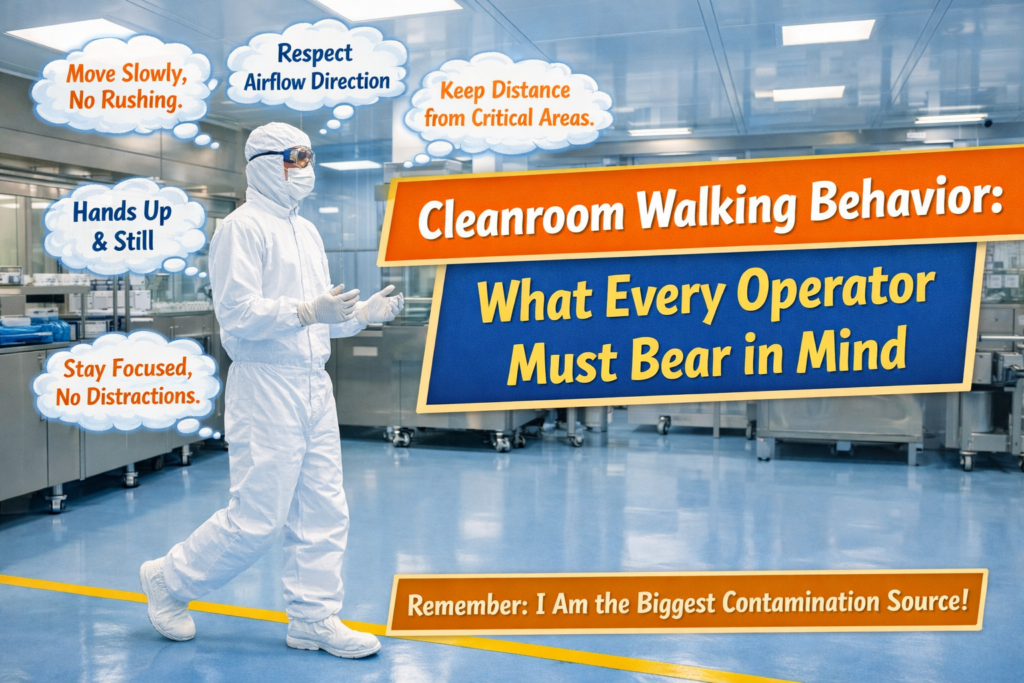
I am the largest source of contamination inside the cleanroom.
Even in full sterile gowning, the human body continuously sheds particles. The way an operator walks, turns, or moves inside the cleanroom directly impacts airflow patterns and particle distribution.
Let us go through what a cleanroom operator must bear in mind while walking inside a pharmaceutical cleanroom.
1. Move Slowly and Smoothly
Fast movement creates turbulence. Turbulence disturbs laminar airflow and resuspends settled particles from the floor and surfaces.
When walking inside a cleanroom:
- Walk slowly and deliberately
- Avoid sudden turns
- Do not drag your feet
- Never run (Except in an unsafe event)
Speed increases particle dispersion. Slow movement preserves airflow integrity.
2. Respect Airflow Direction
Pharmaceutical cleanrooms are designed with controlled airflow patterns, especially in Grade A and B areas.
While walking, an operator must:
- Avoid standing between HEPA filters and critical work zones
- Never block first air over sterile materials
- Avoid leaning over open containers or aseptic operations
- Stay conscious of airflow coming from ceiling to floor (vertical) or back to front (horizontal)
Airflow is the primary contamination control mechanism. Disrupting it increases risk.
3. Maintain Distance from Critical Areas
Not every area in a cleanroom carries the same risk level.
Aseptic filling lines, open product zones, and sterile connections are highly sensitive. Operators must:
- Keep safe distance from exposed product
- Avoid unnecessary presence in critical zones
- Enter Grade A areas only when required
- Plan movement before approaching sterile operations
Crowding increases contamination risk.
4. Keep Hands Under Control
Hands are the most common contamination transfer route.
While walking:
- Keep hands above waist level
- Avoid touching walls, equipment, or gown surfaces
- Do not adjust mask or goggles unnecessarily
- Keep gloved hands within visual control
Unnecessary hand movement increases particle shedding.
5. Maintain Proper Body Position
Body posture influences contamination release.
Operators should:
- Avoid leaning on equipment
- Avoid crossing arms
- Avoid sitting unless procedure allows
- Keep body upright and stable
Friction between gown surfaces can release particles. Minimize unnecessary contact.
6. Follow Designated Walkways
Many pharmaceutical facilities define specific walking paths to maintain personnel and material segregation.
Operators must:
- Follow marked pathways
- Avoid shortcuts across production zones
- Respect one-way movement systems
- Maintain separation between personnel and material flow
These controls are part of the contamination control strategy, not just the facility layout.
7. Stay Mentally Alert
Cleanroom behavior is a mindset.
While walking, an operator should constantly think:
- Am I disturbing airflow?
- Am I too close to a critical area?
- Is my movement necessary?
- Am I minimizing contamination risk?
Contamination control begins with awareness.
Why Cleanroom Walking Behavior Matters
Improper walking behavior can lead to:
- Increased non-viable particle counts
- Environmental monitoring excursions
- Microbial contamination events
- Sterility test failures
- Regulatory observations
Regulatory inspectors frequently observe personnel behavior during audits. Poor movement discipline reflects a weak culture of contamination control. The cleanroom walking behavior is observed during failure investigations.
Terminal Sterilization vs. Aseptic Manufacturing
Lyophilization in Pharmaceuticals: Definition, Process, Importance, and Applications