Microbiology techniques in pharmaceuticals are the most critical skill sets a microbiology professional can master. These techniques are highly sensitive, and any minor error, contamination, or mishandling can lead to inaccurate test results, product rejections, regulatory non-compliance, and in some cases, patient risk.
When microbiological data comes into question, it often triggers a detailed deviation investigation that consumes significant time and resources. The reason is that most microbial tests involve humans rather than instruments. That’s why it is essential for every microbiologist working in pharmaceuticals to be proficient in the core microbiology techniques that form the backbone of environmental monitoring, sterility testing, microbial limits testing, and contamination control.
Let’s explore the five essential microbiology techniques in pharmaceuticals that make you a perfect microbiologist.
Why Microbiology Techniques Are So Sensitive?
Before we get into individual methods, it’s important to understand why microbiology techniques require such care. Unlike many chemical assays, microbiological tests deal with living organisms. The microorganisms that can multiply, move, and enter our products in unexpected ways. A single lapse in aseptic practice or incorrect pipetting can introduce contaminants or cause inaccurate counts. This is why pharmaceutical microbiology labs operate under strict Good Manufacturing Practices (GMP) and robust Standard Operating Procedures (SOPs).
Even the best-designed laboratory can be compromised by poor techniques, as it depends on microbiologists. That’s why training, validation, and continual monitoring of proficiency are essential.
Let’s look at the core microbiology techniques you must master to maintain the highest standards of accuracy in the pharmaceutical industry.
1. Plating Techniques
Streak Plate Technique
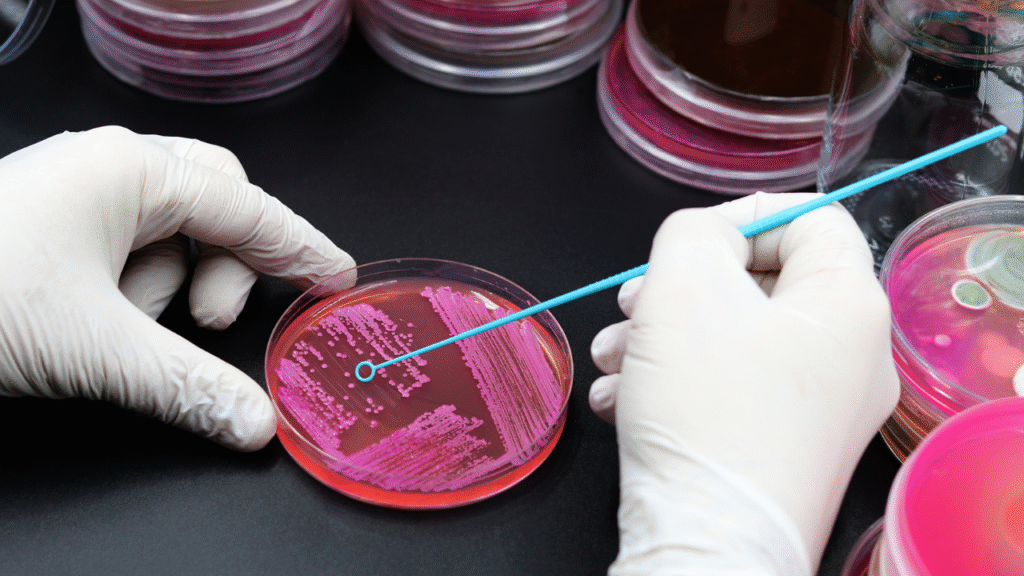
The streak plate technique is used to isolate pure colonies from a mixed culture by gradually thinning out the sample over the agar surface. This technique is essential for identifying individual microorganisms, performing microbial identification, and confirming the purity of cultures. In pharmaceuticals, streak plating helps ensure that contaminants are identified accurately.
Spread Plate Technique
In the spread plate method, a measured volume of diluted sample is evenly distributed over the agar surface with a sterile spreader. This technique allows for the enumeration of microorganisms in a sample, which is crucial for microbial limits testing.
Pour Plate Technique
Pour plating technique involves mixing the diluted sample directly with molten agar and pouring it into a petri dish, where colonies grow both on the surface and within the medium. This method is useful for counting microorganisms present in low numbers or for testing anaerobic bacteria. Proper execution ensures accurate microbial counts (bioburden), a vital parameter in product release testing.
Why Important: All plating techniques require thorough aseptic handling to deliver valid colony counts that directly impact batch release and compliance.
2. Serial Dilutions
Serial dilution involves stepwise dilution of a sample to reduce the concentration of microorganisms to a countable range. For example, if a sample has too many bacteria to count, diluting it 1:10 multiple times makes it possible to plate and quantify them accurately. This technique is necessary in microbial enumeration, bioburden testing, preservative efficacy testing, and many validation studies.
Why Important: Incorrect dilution factors or improper mixing can lead to drastically wrong counts.
3. Pipetting Techniques
Pipetting may look simple, but precision pipetting is the foundation of microbiological accuracy. Every transfer, whether adding diluent, media, or sample, must be performed with calibrated pipettes, consistent technique, and careful attention to avoid air bubbles or cross-contamination.
Why Important: Variability in pipetted volumes directly affects dilutions, endotoxin test, and microbial counts. In a pharmaceutical microbiology lab, even a small error can compromise the integrity of your results.
4. Gram Staining
Gram staining is a differential staining technique that classifies bacteria as Gram-positive or Gram-negative based on cell wall properties. In pharmaceuticals, it is routinely used for the identification of isolates and contamination tracking. Many microbiologists fail to execute the Gram’s staining technique properly and fail to describe the Gram’s nature of the microorganism.
Why Important: Accurate Gram staining is essential for identifying microbial contaminants quickly during investigations or environmental monitoring excursions.
5. Aseptic Techniques
Aseptic technique involves all practices used to prevent contamination of samples, reagents, and the laboratory environment. This includes working within laminar airflow hoods, flame sterilization of tools, use of disinfectants, and personal protective equipment.
Microbiologists must ensure the following while conducting a microbial analysis.
- Frequent hand sanitization during analysis.
- The validity of the sterilized materials.
- Sterilization status of apparatus.
- Cleanliness of the Biosafety cabinet.
- Minimize the exposure time of media within a biosafety cabinet.
- Proper cleanroom gowning.
Why Important: Aseptic technique is the most critical microbiology technique in pharmaceuticals because any contamination can cause false positives, failed tests, or worse, releasing a contaminated product.
Final Thoughts
Microbiology techniques in pharmaceuticals are among the most critical that one should master. By mastering these microbiological techniques, you protect your work’s integrity, support your company’s reputation, and contribute to a culture of quality and compliance.
Remember, in pharmaceutical microbiology, there is no room for shortcuts.
If you’re a microbiologist working in pharmaceuticals, continuously refine your skills to become an ideal microbiologist. Your commitment to excellence in microbiology techniques will set you apart as a reliable professional.