Sterility testing is one of the most sensitive microbiological tests performed in the pharmaceutical industry, and Fluid Thioglycollate Medium is a critical medium for detecting microbial contamination, particularly organisms that grow in low-oxygen or oxygen-free environments. Fluid Thioglycollate Medium, commonly abbreviated as FTM, is designed not just to support microbial growth but to create a gradient of oxygen availability within a single container. This unique characteristic allows microbiologists to detect a wide range of microorganisms.
Composition of Fluid Thioglycollate Medium (FTM)
Fluid Thioglycollate Medium is a complex, reducing, enrichment medium formulated to support aerobic, microaerophilic, and anaerobic microorganisms within a single container. Each ingredient plays a specific functional role.
Pancreatic Digest of Casein
This component serves as the primary nitrogen source. It provides peptides and amino acids required for microbial growth and repair. It supports the recovery of stressed and injured microorganisms commonly encountered during sterility testing.
Yeast Extract
Yeast extract supplies B-complex vitamins, trace elements, and growth factors. These nutrients enhance the recovery of fastidious organisms and improve the overall growth-promoting ability of the medium.
Dextrose (Glucose)
Dextrose acts as an energy source. It supports rapid microbial metabolism and growth, especially for organisms present in very low numbers.
Sodium Thioglycollate
Sodium thioglycollate is a key reducing agent. It lowers and maintains the redox potential of the medium by neutralizing dissolved oxygen. This creates and preserves anaerobic conditions, protects oxygen-sensitive enzymes, and supports recovery of anaerobic and facultative anaerobic microorganisms. It can also neutralize the mercurial preservatives of pharmaceutical products.
L-Cystine
L-cystine works synergistically with sodium thioglycollate. It enhances the reducing capacity of the medium and stabilizes anaerobic conditions over the incubation period.
Sodium Chloride
Sodium chloride maintains osmotic balance, creating an environment compatible with microbial cell integrity and growth.
Agar (Low Concentration)
A small amount of agar increases the viscosity of the medium. This slows oxygen diffusion from the surface and helps maintain the characteristic oxygen gradient without solidifying the medium.
Resazurin Sodium Solution
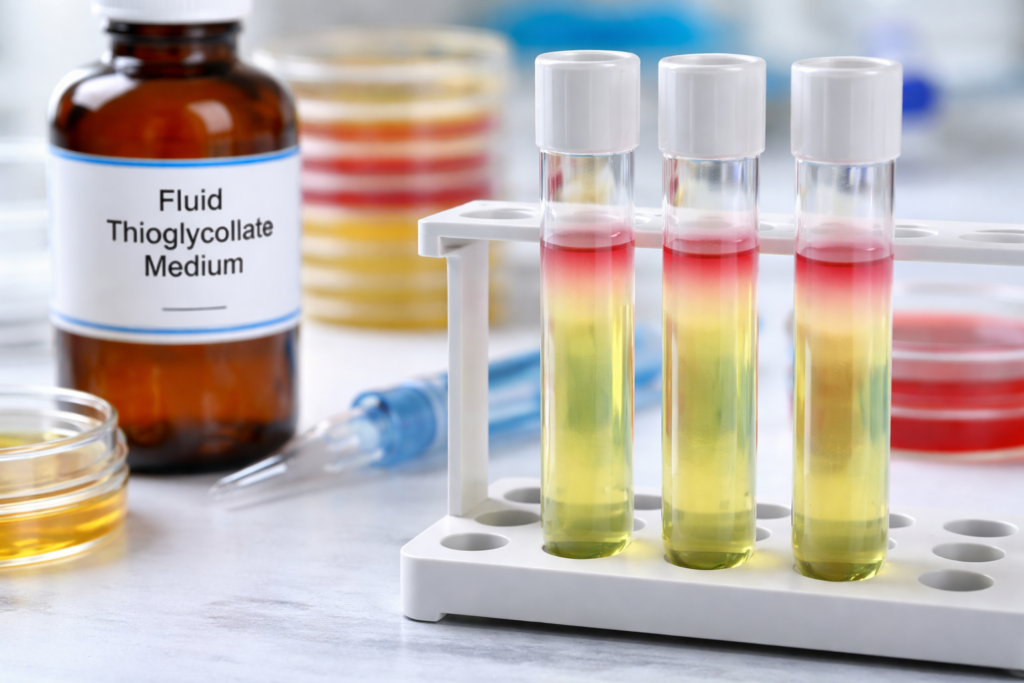
Resazurin is an oxidation–reduction indicator. It turns pink in the presence of oxygen and remains colorless under reduced conditions. The thin pink ring at the top of the medium visually confirms limited oxygen penetration and proper medium performance.
Purified Water
Purified water acts as the solvent for all components and ensures uniform distribution of nutrients and reducing agents.
The Oxygen Gradient
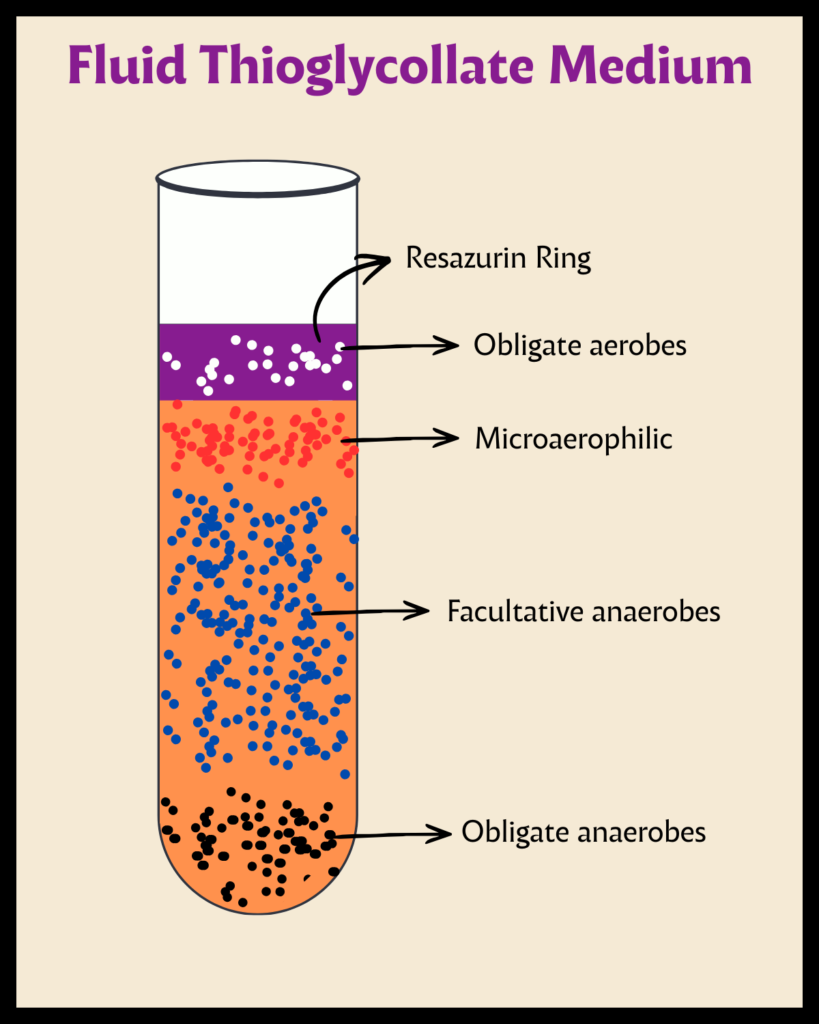
Once Fluid Thioglycollate Medium stands undisturbed after preparation, it naturally forms distinct oxygen zones from top to bottom. This feature allows different types of microorganisms to grow at locations that match their oxygen requirements.
At the top of the medium, oxygen concentration is highest due to direct contact with air. This zone supports the growth of obligate aerobes, organisms that require oxygen for survival.
Just below the surface lies a microaerophilic zone, where oxygen levels drop slightly. Microorganisms that prefer reduced oxygen conditions grow well here.
The middle portion of the medium contains very little oxygen. Facultative anaerobes thrive in this region because they can adapt to both aerobic and anaerobic conditions.
At the bottom of the container, oxygen is almost absent. This zone supports the growth of obligate anaerobes, which cannot survive in the presence of oxygen.
The ability to observe growth at different depths gives microbiologists valuable clues about the nature of the contaminant.
The Role of the Resazurin Ring
One of the most visually important features of Fluid Thioglycollate Medium is the resazurin indicator, often seen as a thin pink band near the top of the medium.
Resazurin indicator turns pink when oxygen is present and remains colorless when oxygen is absent.
In a properly prepared Fluid Thioglycollate Medium, oxygen should exist only at the surface because oxygen enters the medium from the air.
If resazurin appears pink throughout the medium, it indicates that oxygen has penetrated the entire depth of the medium., which makes the medium not suitable for use.
A resazurin ring confined to the top layer confirms limited oxygen penetration and suitable anaerobic conditions, whereas uniform pink coloration indicates excessive oxygenation and renders the medium unsuitable for sterility testing.
Common reasons this happens
This usually occurs due to one or more of the following:
- Excessive heating or boiling during preparation
- Improper storage with loose caps or repeated opening
- Over-shaking or agitation before use
- Prolonged exposure to air
- Expired or improperly prepared medium
- Insufficient sodium thioglycollate activity
Why This Is a Critical Issue in Sterility Testing
When the entire medium turns pink:
- Obligate anaerobes will not grow
- Sterility test results become unreliable
- Gives a false-negative result
From a regulatory standpoint, this is a medium failure, not a test failure.
Microorganisms Detected Using FTM
Obligate Anaerobic Bacteria
FTM is primarily intended to detect obligate anaerobes, which cannot grow in the presence of oxygen.
Common examples include:
- Clostridium species
- Bacteroides species
- Fusobacterium species
These organisms grow at the bottom of the medium, where oxygen is absent. Their detection is critical in sterility testing of parenteral and implantable products.
Facultative Anaerobic Bacteria
Facultative anaerobes can grow with or without oxygen. FTM supports their growth throughout the medium.
Common examples include:
- Staphylococcus aureus
- Escherichia coli
- Salmonella species
- Enterococcus species
These organisms often show diffuse turbidity across multiple zones.
Microaerophilic Microorganisms
Microaerophiles require reduced oxygen levels and grow best just below the surface of the medium.
Examples include:
- Campylobacter species
- Helicobacter species
Growth typically appears in the upper-middle region of the medium.
Aerobic Bacteria (Limited Detection)
FTM can also detect aerobic organisms, but it is not optimized for them. Aerobes grow mainly near the surface where oxygen is present.
Examples include:
- Bacillus species
- Pseudomonas aeruginosa
This is why pharmacopeias require Soybean Casein Digest Medium (SCDM) in parallel with FTM for sterility testing.
Soybean Casein Digest Medium (SCDM) and Its Role in Media Fills