As the pharmaceutical industry moves toward digital records and electronic systems, the USFDA has clearly explained what metadata is, why it matters, and how it must be maintained under CGMP requirements.
What Is Metadata?
Metadata is the contextual information required to understand data.
In simple words, metadata is “data about data.”
A single data value does not mean much on its own. To understand it correctly, we need additional information. That additional information is metadata.
Simple Example
The number “23” alone has no meaning.
But when metadata is added:
- Value: 23
- Unit: mg
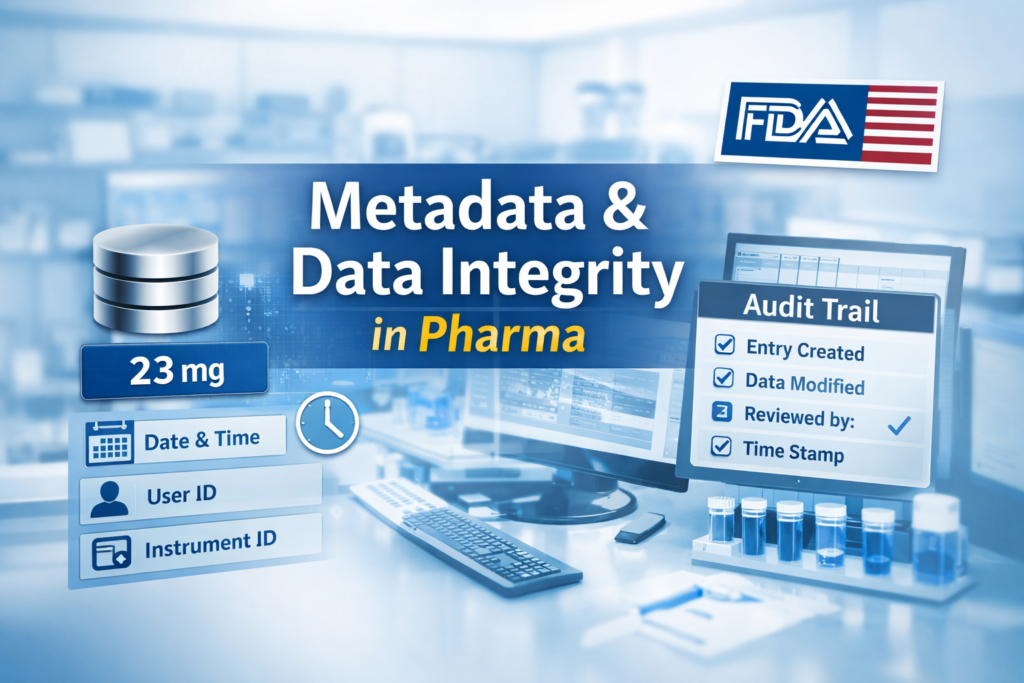
Now it becomes meaningful: 23 mg
Without metadata, data can be misunderstood, misused, or become completely useless. For any test, analysis, or manufacturing activity, metadata may include:
1. Date and Time Stamp: When the data was generated. Example: test start time, test end time
2. User ID: To understand who performed the activity.
3. Instrument ID: Which equipment or system was used. Useful during investigations and audits
4. Audit Trails: Records of any changes made to the data. Shows what was changed, when, and by whom
5. Method and Version: Test method and Software version used for analysis.
All these elements together make the data complete, traceable, and reliable.
USFDA Definition of Metadata (Simplified)
According to the USFDA, metadata is:
Structured information that describes, explains, or makes it easier to retrieve, use, or manage data.
This means metadata is not random information. It is organized and directly linked to the data it describes.
Why Is Metadata Important?
Metadata helps us:
- Understand what the data represents
- Know how and when the data was generated
- Identify who generated the data
- Trace which instrument or system was used
- Verify data integrity and authenticity
In the pharmaceutical industry, where product quality and patient safety are critical, metadata is just as important as the data itself.
USFDA Expectations Under CGMP
The USFDA clearly states that:
Data must be maintained throughout the record retention period with all associated metadata required to reconstruct the CGMP activity.
This means:
- Data and metadata must be stored together
- They must be available for the entire retention period
- They must allow regulators to reconstruct what actually happened
This requirement aligns with CGMP regulations such as:
- 21 CFR 211.188 – Batch production and control records
- 21 CFR 211.194 – Laboratory records
Common FDA Observations Related to Metadata
USFDA inspections often cite issues such as:
- Missing audit trails
- Shared user IDs
- Deleted or overwritten raw data
- Inability to retrieve original data
- Incomplete electronic records
These observations can lead to:
- Form 483 observations
- Warning letters
- Data integrity remediation programs
Best Practices for Managing Metadata
To comply with USFDA expectations, companies should:
- Train employees on data integrity
- Use validated electronic systems
- Prohibit shared user accounts
- Review audit trails regularly
- Back up data
- Include data checks during internal audits
Metadata is not optional or secondary information. It is an essential part of pharmaceutical data. Without metadata, data loses its meaning, reliability, and regulatory acceptance. In today’s digital pharmaceutical environment, data without metadata is incomplete data.